


On July 2, 1976, President Gerald Ford, Chief Justice Warren Burger, and House Speaker Carl Albert appeared at the National Archives to pay tribute to the 200th anniversary of the Declaration of Independence – a document which President Ford described as “the fixed star of freedom of the United States.”1 They were joined by a gallery of Washington elites, including Vice President Nelson Rockefeller, Secretary of State Henry Kissinger, and Associate Justice Harry Blackmun. Ford, Burger, and Albert’s prepared remarks kicked off a 76-hour public viewing of the Declaration of Independence, the Constitution, and the Bill of Rights. Those who attended the evening signed a guest book prior to their departure, the pages of which were subsequently sealed in a time capsule to be opened in 2076.
This would not be the first time that Chief Justice Burger addressed the importance of this venerated document. He first traveled to the National Archives in July 1971, where President Richard Nixon, House Speaker Albert, and Burger led a nationally televised “historic kickoff ceremony” for the upcoming bicentennial. In September of 1975, he spoke to the Utah American Revolution Bicentennial Celebration about the Declaration’s upcoming anniversary, and his comments were reprinted in several national publications. And, as discussed below, then-Judge Burger even shared his thoughts on the Declaration with a St. Paul elementary school student.
Moreover, it would not be the last time that Chief Justice celebrated a foundational political document; he resigned his seat on the Supreme Court in 1986 to focus his full energies to serving as chairman of the Commission on the Bicentennial of the Constitution. As our nation prepares to now celebrate the 250th anniversary of the Declaration of Independence, we wanted to briefly share Chief Justice Burger’s views of the Declaration as expressed in private and public remarks over the years.
In February of 1961, a young sixth-grade student from St. Paul, Minnesota, sent a letter to Warren Burger, then a federal court of appeals judge. In the letter, Joellen Tate wrote that her class wanted to honor “our many privileges we enjoy here in the United States by becoming better citizens” and by creating “a children’s code by which we may try to live this year.” As part of writing a code, Joellen asked Burger, “what you think would be some of the things that make for good citizenship and that would help us to become a finer and better person?” In his April 4, 1961, response, Burger spoke of the importance of faith, tolerance, and a basic understanding of history. He reminded the young students of the impact of teachers on their lives. And he concluded as follows:
Certain things in the beginnings of our nation you must know, and I shall cite just one, in the hope you and our classmates will memorize it and never forget it. It is a statement of why our forefathers made this a nation nearly 200 years ago. It is this: “We hold these truths to be self-evident, that all men are created equal, that they are endowed by their Creator with certain unalienable rights, that among these are life, liberty and the pursuit of happiness. That to secure these rights, governments are instituted among men, deriving their just powers from the consent of the governed.” If you will learn this and never, never forget it, I think you will all be good citizens.2
April 4, 1961, letter from Warren Burger to Joellen M. Tate
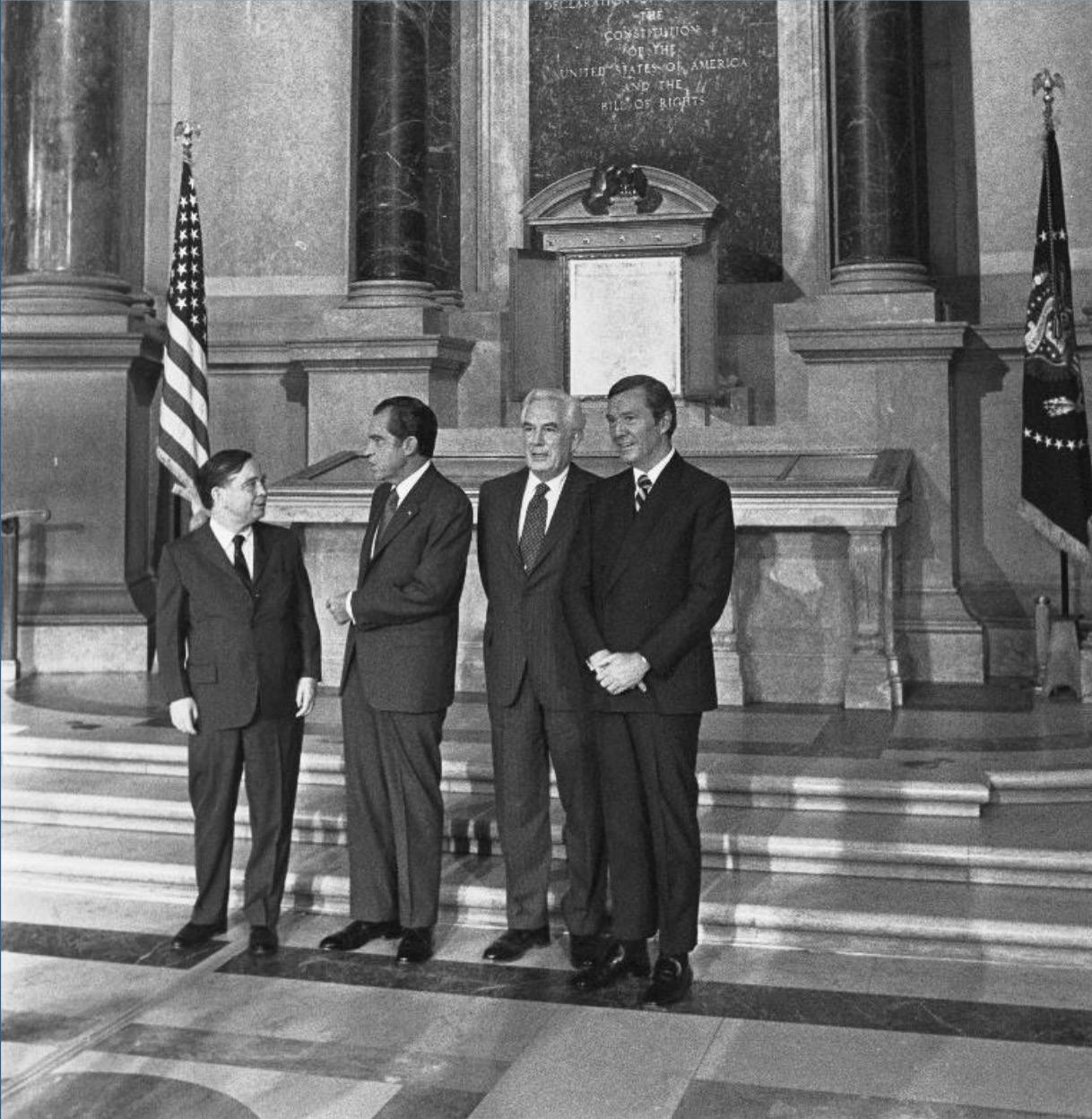
When we celebrate the 200 years of the Declaration of Independence, in 1976, we will honor a period in the life of our country rather than a single event. July 4, 1776, was a great occasion in our history and in the history of mankind, because it was the beginning of 15 years of startling developments. In that very brief period – the time it takes for a boy or girl, today, to go from primary school to the third year in college – a handful of men in our small country with a population of only a few million people wrote the Declaration, the Constitution, and the Bill of Rights and literally shook the world with a new idea of government.
These three remarkable documents, that we see here tonight, gave oppressed people everywhere new heart, and the world was never quite the same after that. These men create a new form of revolution – that ebbs and flows but never ceases and never needs force or violence.
…But even after the Declaration, and after the Constitution, there was such deep concern that the people be protected from arbitrary action of government that in 1791 the Guarantees of the Bill of Rights were added to the Constitution. These Guarantees made more certain that the promises of the Declaration would be fulfilled, and that such great rights as freedom of worship, freedom of expression, and due process of law could never be withdrawn from the people without their consent.
These were revolutionary ideas, and with them, we began a very special kind of revolution that has gone on to this very day. Those who are impatient for change should see that no nation in all history has given so much power to the people, and no people have used that power more often and more wisely to improve their lives and secure their liberties. This revolution of ours will soon be 200 years old, but it is still youthful and vital. Every day is the beginning of a new phase in this kind of evolution – it is a steady, slow, often silent and almost unseen revolution, but it is one that works constantly to improve the quality of life. It will always work that way if we make it work.
Remarks at the National Archives, American Revolution Bicentennial Era Ceremony, July 3, 1971.3
For 200 years, philosophers, historians, and political scientists have called our Declaration of Independence one of the most momentous political documents in all of history. The basic ideas it advanced had been expressed many times before 1776, but never before had they been assembled in one instrument to outline a charter of liberty. It severed our political ties with the mother country, stated the reasons for that separation, and became a guide for the framers of the Constitution. It gave more than independence – it gave opportunity.
The colonists who settled on the Eastern Seaboard had to be strong, self-reliant, and confident people, or they would not have survived for more than a century in that primitive wilderness, and they would never have succeeded in turning it into a thriving, orderly society. Those qualities enabled them to carry on from the landing at Jamestown up to 1776. The Declaration gave them new impetus to those qualities and, in turn, led to the creation of new institutions, new industries, and the expansion of education without class barriers. The Constitution that implemented the Declaration made our country the first nation in history to establish a system of government under a written document by which the people voluntarily delegated powers to a central government, organized with an ingenious system of three divided and separated departments. This mechanism provided checks and balances on governmental power which, in turn, released the creative powers of a whole people.
Remarks before the Utah American Revolution Bicentennial Celebration, September 6, 19754
The Declaration of Independence that is being honored tonight had no binding legal effect when it was announced 200 years ago, but it guided the men who, 11 years later, drafted the Constitution. The Declaration was a statement of intent and purpose. The Constitution was a compact of people, a contract, if you will, to carry out the Declaration…[t]hese two documents, the Declaration and the Constitution, embark[ed] the American people on an experiment in a new form of Government, self-government, that has survived longer than any other kind of Government in recorded history. In this experiment, that remarkable group of American leaders wisely recognized the paradox of freedom that to preserve liberty, each one of us must give some of it up.…. We have survived and prospered for 200 years now because the strength of our Nation was not simply in the words of the Declaration and the Constitution, great as they are, but because of the strength of the people, of personal integrity, of individual responsibility, and of the tradition of home and family and of religious beliefs.
Remarks at the National Archives, July 2, 1976.5
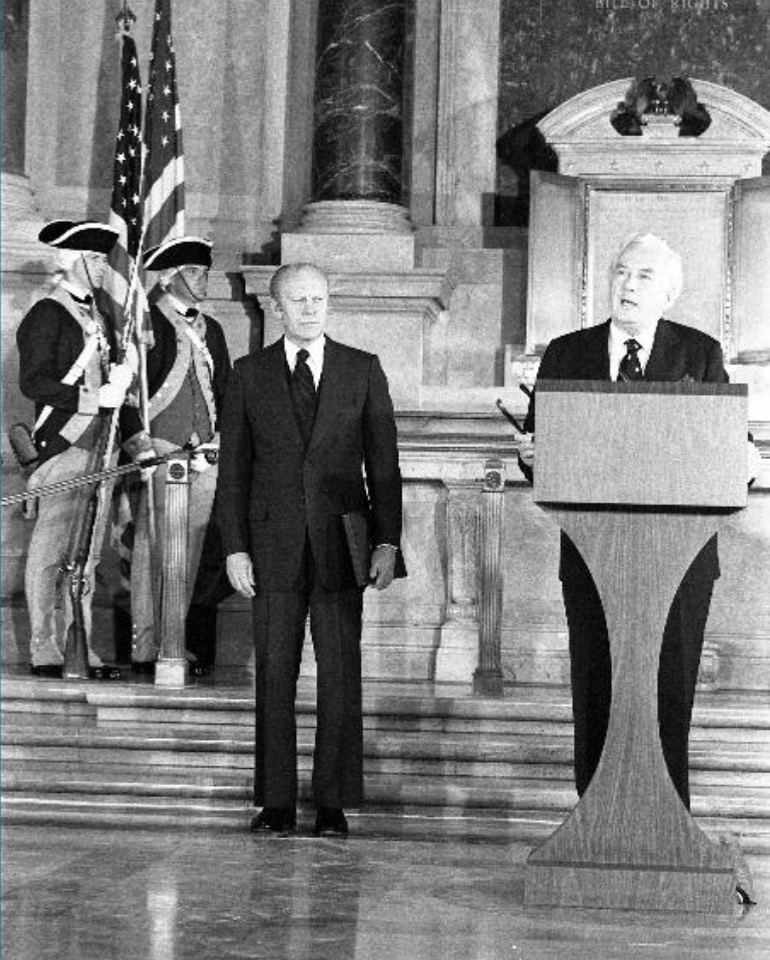
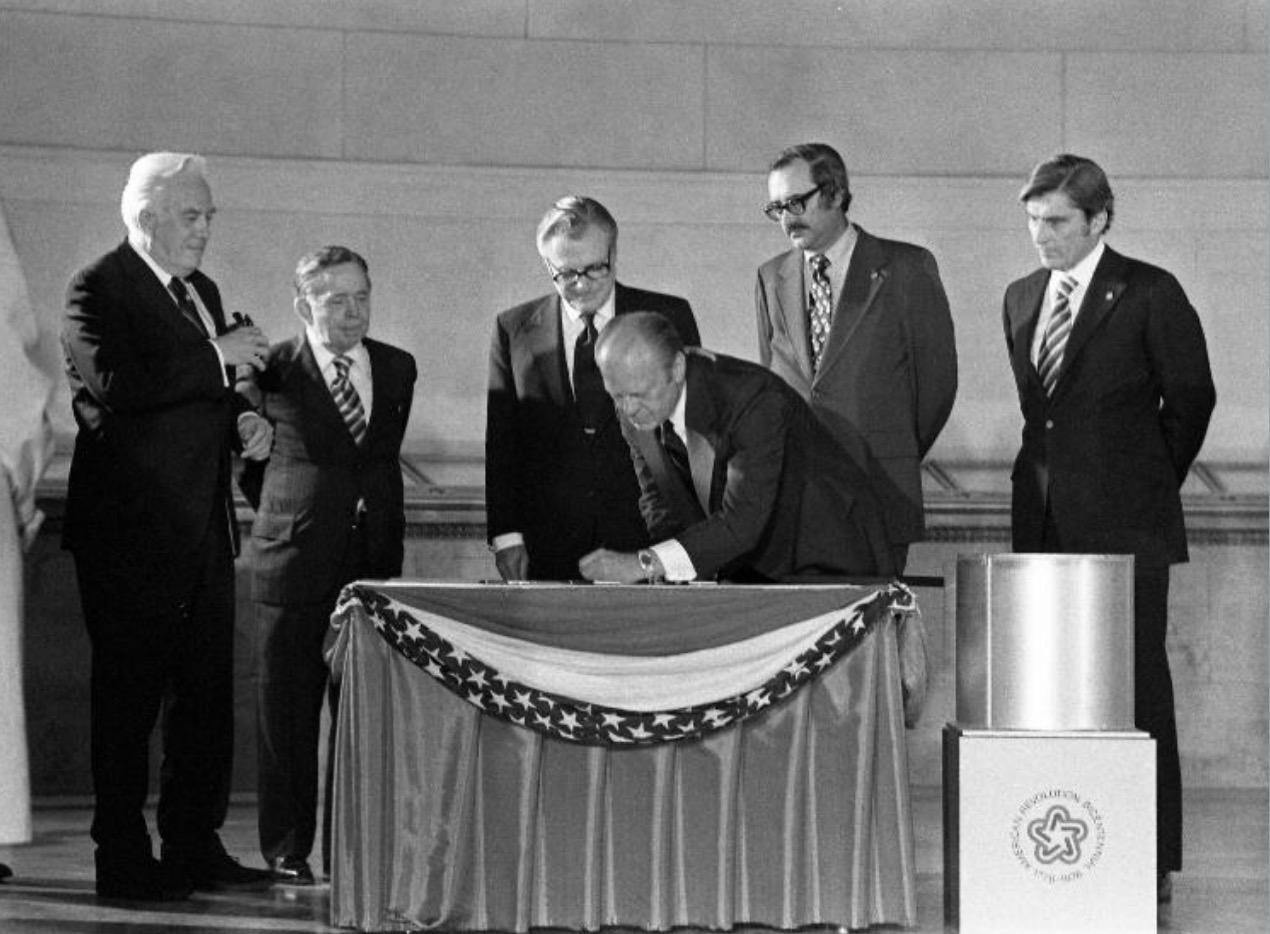
President Gerald Ford listens to Chief Justice Warren Burger’s comments at the National Archives on July 2, 1976 (left); President Ford signing the National Archive’s guest registry as Chief Justice Burger and other dignitaries observe (right). Photographs courtesy of the Ford Presidential Library.
The Declaration of Independence and the Constitution were only promises of freedom, of ideals declared, and of hopes for the future. It took people and leaders of courage, determination, and imagination to make that system work. But we can never regard our freedoms or our systems as totally secure. They are being challenged today – challenged from the outside and challenged even from within – and often eroded by well-meaning people.
Remarks of Warren E. Burger, Dedication of the Norton Clapp Law Center, University of Puget Sound School of Law, September 13, 1980.6
As a postscript, we note that Chief Justice Burger is not the only justice to publicly laud the Declaration of Independence. In his most recent “Year End Report on the Judiciary,” Chief Justice John Roberts wrote that “the Declaration of Independence stands as one of the most widely read and emulated political documents in history” and that it “has played a signal role in the development of the Nation’s constitutional, statutory, and common law.”7 And recently Associate Justice Neil Gorsuch co-authored a children’s book celebrating the Declaration.8
Not all justices, however, have universally praised the document. In a 1987 essay about the bicentennial of the U.S. Constitution, Associate Justice Thurgood Marshall observed that the document’s drafters “did not have in mind the majority of America’s citizens” when they penned the words “We the People.”9 Excluded from the political community were enslaved individuals as a result of the political compromise between Northern and Southern politicians. He adds that this morally suspect compromise is reflected in the Declaration.
Even these ringing phrases from the Declaration of Independence [self-evident truths about the equality and rights of man] are filled with irony, for an early draft of what became that Declaration assailed the King of England for suppressing legislative attempts to end the slave trade and for encouraging slave rebellions. The final draft adopted in 1776 did not contain this criticism.10
Chief Justice Earl Warren shared Justice Marshall’s view that the promise of the Declaration’s “ringing phrases” was not immediately realized. “We started wrong, of course, by tolerating the cruel institution of human slavery which was in direct contradiction of the noble phrase in our Declaration of Independence…[i]t took almost a hundred years for us to absolve ourselves from the curse of slavery through the Thirteenth, Fourteenth, and Fifteenth Amendments to our Constitution.”11 We have no doubt that Chief Justice Burger shared these criticisms. Perhaps he felt, as a sitting justice formally celebrating the anniversary of a venerated foundational document, that condemnation of the Founders – no matter how valid – was not appropriate.